

ricg.over-blog.com/
6 Janvier 2021

Google Now that Google Drive storage is stupid-cheap (e.g., two bucks per month for 100GB), you might be wondering about its viability as a backup tool. To backup files to Google Drive, here you need to click Backup, select File Sync. Click Add Folder and select the folder you want to backup. Note: If your folder has multiple files inside, you can set auto file extension with Filter Settings (Supported by AOMEI Backupper Professional ). How to install the new Backup and Sync desktop app for Google Drive. This is the replacement for the old Google Drive desktop app. Backup Computer to Google Drive Using Backup and Sync The first step is to download Backup and Sync tool from Google Drive, as available for both Mac and Windows PC. Once 'Backup and Sync' is downloaded to your computer, launch the tool by clicking on it and it will start the process of setting up your computer for backup to Google Drive.
As our digital libraries get larger and larger, we're fortunate to be living in a time when cloud-based storage keeps getting cheaper and cheaper.
Whether you're ready to ditch physical backup drives or you're looking for the convenience of online file storage, it's easy to get started and stay synchronized. You probably already have a Google account with space available on Drive; why not use it to protect your vital files and folders?
I'm stepping through this process using a Windows machine, but it's a similar affair on a Mac. Let's light this candle.
You'll obviously need enough storage in your Google account to back up all your files, so swing by your storage page to see what's available.
I pay $30 a year for 200 GB of storage, which has been more than enough for me. You can get 100 GB for $20 a year or, if you've got a lot of big files—such as videos, for instance—the $99-per-year 2 TB option might be your best bet.
At the very least, make sure you have at least some storage available—perhaps tens of gigabytes—and then pay for more storage if you run out of space. You can also use Google's storage management tool to free up some space in your account as well.
You'll need to download Google's Backup and Sync tool, which is a reasonably painless piece of software that runs in the background.
Once that's done, install the app and sign in to your Google account once it's running.
Now's the fun part: deciding which folders to immortalize. Google will suggest some oft-backed-up folders for you, and you can add any other folders you'd like to back up by clicking the 'Choose Folder' link and selecting your additional folders.
From this screen, you can also choose to shrink any photo uploads somewhat and have them not count against your storage quota. To do that, choose the 'High quality (free unlimited storage)' option. There's a handy option that uploads photos and videos directly into your Google Photos account as well.
Once you're ready, click the Next button.
If you've already got a bunch of stuff stored on Google Drive and you'd like to keep a copy on your computer, you can do so in this step. Choose to sync everything or only specific folders. This is also a great option for synchronizing files between two or more computers.
If you only want to back up your computer's files into Google Drive, uncheck the 'Sync My Drive to this computer' up at the top of the modal.
Once you're ready, click the blue Start button in the lower-right corner and . . . well, that's about it. The files in the folders you've selected for backup will start making their way to your Google Drive account.
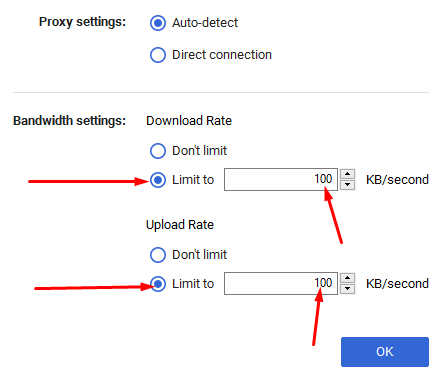
The process could take hours (or days) if you have a lot of big files and/or a slow internet connection. If you have a slow connection, it's a good idea to limit the amount of bandwidth the app is allowed to use for uploading and downloading your files.
To change this setting, open the Backup and Sync app, select the Settings menu, and then click the 'Network Settings' link.
Run a speed test on your machine—here's a good one—and then plug your download and upload results into this calculator here.
Then divide the results by 10 and enter them into the bandwidth settings of the Backup and Sync app so that you're allowing only about 10% of your download and upload bandwidth to be used for backups.
It could be argued that you can never have too many backups. At the very least, it's never a bad idea to have a cloud backup and a physical backup.
And if you thought online storage was getting cheaper and cheaper, then wait until you get a load of how cheap physical backup drives have gotten. Search your favorite retailer and you'll likely be able to find 4 TB drives at south of $100.
Using software that comes with the drive, the setup process should be roughly the same as what's been outlined above: connect the drive, choose the folders to back up, and let it do its thing. (If you're on a Mac, you can use Apple's Time Machine utility.)
Two big features you'll want to look for are automatic backups—which should be table-stakes at this point—and the ability to access your backed-up files remotely like you can with Google Drive.
Google Drive is an online file storage service from Google that allows you to store yourimportant files online and access them anywhere there is an available internet connection.Besides, Google Drive also provides the free web-based applications for you to convenientlycreate documents, spreadsheets, presentations and more.
Google Drive is rated as one of the most popular cloud storageservices among countless users in the market today. It offers 15 GB of free storagespace, with which you can store or back up many types of files that are quite important foryour work, study or life. Compared with backing up files to local or external hard drives,Google Drive does a great job of keeping your files online, making them stay much safer.
Because if the hard drives get damaged accidentally, you will lose all the files backed upbefore, but if you back up files in the Google Drive, you can always access the files onother computers only with an available internet connection. That might be the leading reasonwhy so many people use Google Drive to back up data.
It's easy to back up files from your computer to Google Drive, you just need to uploadthem to the cloud drive as following steps.
(1) Enter the Google Drive main page via browsers like Google Chrome. Locate and select theNew button, then click File upload or Folderupload (ex:File upload).
(2) Locate and select the file(s) you want to upload, then click Open.
(3) The file(s) will be uploaded to your Google Drive.
Note: Depending on your browser and operating system, you may be able toupload files by clicking and dragging a file from your computer into yourGoogle Drive.
Besides backing up files to Google Drive through the browser, you can also download theGoogle Drive desktop app, and simply copy some files to the Google Drivesync folder.
If you think the method described above is too complicated, you might be searching for a moreconvenient and flexible way. Good news, the AOMEIBackupper Standard will satisfy you. As a free Google Drive backup software, itallows you to backup files to Google Drive automatically with a simple setting on allWindows PC operating system. First of all, you need to download a Google Drive deskapplication from its official site, then launch the program and log in to your account.
Step-by-step tutorial on how to back up files to Google Drive in Windows 10.
(1) Download the free backup software. Install and launch it.Select File Backup under the Backup tab.
(2) In the next windows, you can set the Task Name to distinguish thisbackup from others easily later. Click Add File or AddFolder to select the files/folder that you wish to backup.
(3) Choose 'Select a cloud drive' and specifiy the Google Drivefolder as the destination location to store the backup.
(4) Click Schedule to set up an automatic backup on daily/weekly/monthly ifyou want to back up files to Google Drive automatically. Then, click StartBackup.
Just in a few minutes, the files could be backed up to Google Drive. Additionally, AOMEIBackupper could also back up files toOneDrive, Dropbox, Amazon Cloud Drive, etc. But if you prefer to experience moreamazing features, like synchronizing files& folders in real-time, system clone, backup/restoring dynamic disk volume andmore, you can try AOMEI Backupper Professional.


/image%2F6220366%2F20210110%2Fob_c6947a_yosemite-install-disk.jpeg)
/image%2F6220366%2F20210110%2Fob_553aa2_10-7-update-for-mac-download.jpeg)
/image%2F6220366%2F20210110%2Fob_a6b749_adobe-acrobat-pro-dc-full-installer.jpeg)
/image%2F6220366%2F20210110%2Fob_5a918f_bluestacks-4-google-play.png)